
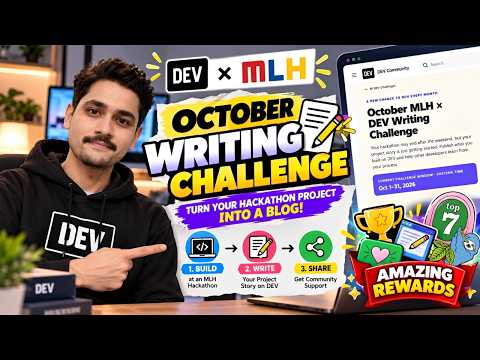
💰 REWARD: $100 PER SELECTED PROJECT
📅 Challenge period: October 1–31, 2026
✍️ Platform: DEV Community
🏆 Selection: DEV editorial team
🏷️ Required hashtag: #mlhacks
Important: This is a competitive writing challenge, not a guaranteed reward for everyone who publishes an article.
🚀 What Is the MLH × DEV Writing Challenge?
The MLH × DEV Writing Challenge is a monthly initiative that encourages developers to document and share projects created at MLH hackathons.
Hackathons often last only a weekend, but the learning continues long after the event ends.
You might have built an AI tool, a productivity application, a web platform, a mobile application, or an experimental project with your team.
This challenge gives you an opportunity to turn that experience into a useful technical article that other developers can learn from.
Your article can explain:
💡 The problem you wanted to solve.
🛠️ The technologies you used.
💻 How you built your project.
🧩 The biggest challenges you faced.
🚀 What makes your solution interesting.
📚 What you learned during the hackathon.
The goal is to help other developers understand your project while showcasing your technical work and creativity.
💰 What Can You Win?
The official challenge page advertises $100 per selected project.
The DEV editorial team will select at least one favourite project each month. Additional projects may also be selected, depending on the number of submissions.
Selection considers several factors:
Technical substance: Does your article demonstrate meaningful technical work?
Originality: Is your project interesting, creative, or different?
Clear storytelling: Can readers understand what you built and why?
Community popularity: Does your post attract genuine interest and discussion?
There is no fixed guarantee that every participant will win.
The best strategy is to write an article that provides real value instead of simply promoting your project.
📅 Important Dates
The October challenge runs from:
Start: October 1, 2026
Deadline: October 31, 2026
Platform: DEV Community
Reward: $100 per selected project
The challenge window follows Eastern Time, so check the official page for the exact closing time.
If you have already built an eligible project at an MLH hackathon, start preparing your article now rather than waiting until the final day.
🎯 Who Can Participate?
This challenge is particularly relevant to developers who have built projects at MLH hackathons.
You may have created:
🤖 An AI-powered application.
🌐 A website or web application.
📱 A mobile application.
⚙️ An automation tool.
🔐 A cybersecurity project.
📊 A data analysis or visualization tool.
🧠 An experimental application using new technologies.
The key requirement is that your project must have been built at an MLH hackathon.
Simply writing about an unrelated personal project does not meet the stated participation process.
If you're unsure whether your event qualifies, check the official challenge page and its participation terms.
✍️ How to Participate — Step by Step
Step 1: Choose Your MLH Hackathon Project
Start with a project you built at an MLH event.
Choose something you can explain clearly, including its purpose, implementation, and the challenges you encountered.
Your project doesn't need to be perfect. Experimental projects and unusual ideas are welcome.
Step 2: Open the Official DEV Submission Template
The challenge page provides an official submission template to help you structure your article.
Use it to organize your project story and ensure you cover the important details.
Start from the DEV Community website and navigate to the official October MLH × DEV Writing Challenge page to access the template.
Step 3: Explain What You Built
Begin with a clear introduction.
Explain the problem, why it matters, and how your application addresses it.
Avoid starting with a long list of technologies without explaining what your project actually does.
Step 4: Describe Your Tech Stack
Tell readers which tools and technologies you used.
For example:
Java or Python for backend development.
React for the frontend.
PostgreSQL or another database.
APIs for external integrations.
AI models for intelligent features.
Cloud platforms for deployment.
Only mention technologies that you genuinely used in your project.
Step 5: Explain How It Works
Describe the architecture, workflow, or important features.
You can include screenshots, diagrams, code snippets, and links to your public repository or demo when appropriate.
Make sure the article is easy to follow for someone who hasn't seen your project before.
Step 6: Share the Challenges and Lessons
Explain what went wrong, how you debugged issues, and what you learned.
Honest technical lessons often make an article more valuable than a story that presents everything as effortless.
Step 7: Publish on DEV
Publish your article on DEV Community during the October challenge window.
Remember to include the required hashtag: #mlhacks.
Follow the official template and any additional participation requirements listed on the challenge page.
Step 8: Share Your Article
Once your post is live, share it with your teammates, friends, developer communities, and social media audience.
Genuine discussion and engagement can help more people discover your work.
Don't use fake engagement or spam communities. Focus on sharing the article with people who may find it useful.
📝 How to Write an Article That Stands Out
Want to improve your chances of being selected? Focus on the quality of your story.
- Start With the Problem
Explain the problem your project solves and why you chose it.
- Show the Actual Project
Include screenshots or a demonstration where possible.
Help readers understand the user experience and the outcome.
- Explain the Technical Decisions
Discuss why you chose your architecture, database, framework, or APIs.
Mention alternatives you considered and any trade-offs you made.
- Share Real Challenges
Explain bugs, limitations, integration problems, or time constraints you encountered during the hackathon.
Describe how you approached them.
- Include a Demo or Repository
If permitted and available, link to your project repository or live demo so readers can explore your work.
- Make It Easy to Read
Use short paragraphs, descriptive Markdown headings, bullet lists, and code blocks only when they help explain your implementation.
- End With What You Learned
Summarize your main lessons and explain what you would improve if you continued developing the project.
💡 Example Article Structure
You can organize your post using this outline:
How We Built [Project Name] at an MLH Hackathon
What We Built
Explain the project and the problem it solves.
Why We Built It
Describe the motivation behind the idea.
Tech Stack
List the technologies used.
How It Works
Explain the architecture and workflow.
Challenges We Faced
Discuss technical problems and solutions.
What We Learned
Share the most valuable lessons.
What's Next?
Describe future improvements.
#mlhacks
Use this as a starting point and adapt it to your actual project.
⚠️ Important Rules to Remember
Before submitting your article, make sure you:
Participate with a project built at an MLH hackathon.
Publish your post on DEV Community within the challenge window.
Explain what you built, how it works, and what you learned.
Include #mlhacks.
Follow the official submission template.
Share your post to help people discover your work.
Read the official terms and any updates about eligibility and badges.
Don't assume that publishing an article automatically earns $100. The editorial team selects projects based on the published criteria.
🏁 Final Verdict
The October MLH × DEV Writing Challenge 2026 is a great opportunity to turn your hackathon experience into a technical article that helps other developers.
You can showcase your skills, share your learning, build your presence in the developer community, and compete for $100 per selected project.
🔥 Quick Recap
🚀 Challenge: MLH × DEV Writing Challenge
📅 Deadline: October 31, 2026
✍️ Platform: DEV Community
💰 Reward: $100 per selected project
🏷️ Required hashtag: #mlhacks
🛠️ Requirement: Write about a project built at an MLH hackathon
🏆 Selection: DEV editorial team
🚨 Ready to Submit?
If you've built something at an MLH hackathon, don't let your project story disappear after the event.
Document your work, explain what you learned, publish your article, and share it with the developer community.
BUILD → DOCUMENT → PUBLISH → SHARE → COMPETE! 🚀
For more hackathons, developer challenges, open-source opportunities, internships, and tech updates, follow Btecky. 💻
Link: https://dev.to/mlh-hackathon